MOUs signed with private sector for rail transport development
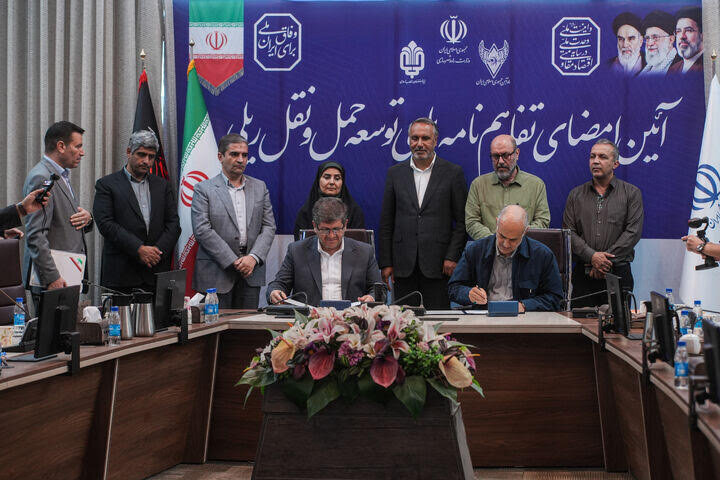
TEHRAN- Five memoranda of understanding for the development of rail transport were signed in the presence of the Minister of Transport and Urban Development, the Managing Director of the Islamic Republic of Iran Railways, the Head of the Mostazafan Foundation, and representatives of the private sector.
According to IRNA from the Ministry of Transport and Urban Development, the signing ceremony for the MOUs on rail transport development was attended by Farzaneh Sadegh, Minister of Transport and Urban Development; Hossein Dehghan, Head of the Mostazafan Foundation; Mohammad Reza Rezaei Koochi, Chairman of the Civil Committee of the Parliament; Jabbar Ali Zakeri, Managing Director of Railways; and a group of senior private sector managers.
These MOUs were signed with the aim of developing rail transport infrastructure, increasing the share of railways in freight transport, strengthening the country’s logistics hubs, expanding transit, and realizing the country’s macro transport policies.
* Signing of MOU for development of logistics and rail cooperation with Sarakhs Border Logistics Center
At this ceremony, an MOU was concluded for the development and strengthening of logistics, transit, and rail transport cooperation at the Sarakhs Border Logistics Center. Based on this MOU, the development of rail infrastructure in the Sarakhs Free Zone across three logistics levels over an area of more than 1,300 hectares, increasing the rail transport capacity of the Sarakhs Border Logistics Center, as well as facilitating customs processes through the supply and installation of required equipment including X-ray machines and weighbridges, will be on the agenda.
* Signing of logistics cooperation MOU with Mostazafan Foundation
Also, a logistics cooperation MOU was signed between the Railways Company and the Mostazafan Foundation of the Islamic Revolution with the aim of designing, creating, developing, investing in, and operating rail freight and container logistics terminals across the national rail network. This cooperation will be implemented in logistics hubs such as Khaf, Aprin, and Zahedan, utilizing the technical and economic capacities of both parties.
* Signing of MOU with shipping logistics holding
Subsequently, a logistics cooperation MOU was concluded between the Railways Company and Hopad Darya Shipping Agency and Port Services Company, representing the Shipping Logistics Holding. This MOU was signed with the aim of developing and operating rail freight and container logistics terminals at rail network logistics hubs and the country’s ports, including the Aprin Logistics Center.
* Signing of MOU with Iran Aluminum Company
Another MOU signed at this ceremony was a cooperation agreement between the Railways Company and Iran Aluminum Company (Iralco), aimed at developing rail transport of raw materials and products of this company. Based on this MOU, cooperation in planning for wagon supply, loading, transport, unloading, as well as determining operational mechanisms and rail transport tariffs will be on the agenda of both parties.
* Signing of MOU with Jahad-e-Eghtesad Institute
Also, a cooperation MOU was signed between the Railways Company and the Jahad-e-Esteglal Institute with the goal of developing import routes and transporting basic commodities through the rail network. This MOU was concluded in line with strengthening passive defense, diversifying sources of supply for basic commodities, increasing the resilience of the country’s supply chain, and implementing government policies in the field of food security.
The Islamic Republic of Iran Railways announced: Based on this MOU, the development of rail transport of basic commodities, reduction of logistics costs and stabilization of transport rates, creation and development of storage warehouses for basic commodities adjacent to rail lines, increasing the share of rail transport in freight transport, development of combined transport, as well as fuel savings and reduction of environmental pollutants will be pursued.
The signing of these five MOUs represents an important step in developing the country’s logistics infrastructure, enhancing the position of rail transport in the supply chain, increasing transit and trade capacity, and achieving the development plan objectives of the country’s transport sector.
* Rail freight capacity to increase to 18 million tons: transport minister
The Minister of Transport and Urban Development emphasized the pivotal role of rail as the backbone of the country’s development and announced plans to increase rail freight capacity from 6.9 to 18 million tons by utilizing existing infrastructure.
According to an IRNA report from the Ministry of Transport and Urban Development, Farzaneh Sadegh made the remarks at the signing ceremony of the five MOUs in the rail transport sector.
The Minister of Transport and Urban Development at this ceremony thanked the support of the Parliament and active companies in the transport sector, calling this cooperation the main reason for encouragement and advancement of development programs.
* Rail: Driver of sustainable development and complement to road network
Sadegh, emphasizing that rail transport is the backbone of the country’s development, stated: To achieve development, special attention to sustainable, affordable, and international rail is a necessity.
She described rail as a driver of sustainable development and added: Rail and roads complement each other, and balanced development of these two sectors is essential for realizing the country’s macro goals.
The member of the 14th government’s cabinet, referring to the strategic Chabahar-Zahedan railway project, clarified: The connection of this rail line has been realized as one of the major infrastructure achievements, and the development of rolling stock and completion of rail corridors in the east of the country continues seriously.
* Gaining private sector trust to strengthen support infrastructure
The Minister of transport and Urban Development, stating that the President personally follows up on the development of rail transport, said: In the 14th government, this is the fifth signing ceremony for contracts and MOUs at the Railways Company. In previous sessions, we focused on developing freight and passenger rolling stock, and now the MOUs have shifted towards upgrading rail support infrastructure.
Sadegh considered gaining investors’ trust as a key role in attracting private sector capital and emphasized that through follow-ups, the process of strengthening infrastructure and developing rolling stock with non-governmental sector participation is expanding.
* Enhancing transit capacity in Sarakhs Free Zone and active transport diplomacy
In another part of her speech, she introduced the Sarakhs Free Zone as one of the strategic points in developing the country’s logistics and transit, adding: Improving service quality and increasing transit capacity in this area requires inter-agency coordination.
The Minister of Transport and Urban Development also referred to the active transport diplomacy of the 14th government with neighboring countries and said: This approach has created significant capacities for the development of logistics centers in Sarakhs, which can lead to attracting and directing transit freight.
* Shifting freight from road to rail: The “Freight Springs” strategy
Sadegh identified one of the main challenges not as a shortage of rolling stock but as ensuring freight is directed to the rail network, and said: A large portion of the freight currently moved by road is transferable to rail.
She stressed: By establishing logistics centers and guaranteeing cargo, we can make maximum use of existing rail network capacities to increase rail’s share in freight transport. Also, given the constraints of southern ports, strengthening entry and exit points at northern, northeastern, northwestern, and southeastern borders is more important than ever.
* Forecast to increase rail freight capacity to 18 million tons
The Minister of Transport and Urban Development, thanking the role of the Mostazafan Foundation and free zones in developing logistics terminals, announced: Expert studies show that merely by utilizing existing capacities and without needing new infrastructure, it is possible to increase rail freight capacity from 6.9 million tons to 18 million tons.
MA
Leave a Comment